Third Quarter 2026 / Strategy Update and Market Overview

As a reminder of our ongoing commitment to keep you informed, your quarterly performance reports are available on our secure WestEnd Client Portal. You can access it anytime here: WestEnd Black Diamond Portal
If you need help logging in, contact us directly or visit this page for instructions: Client Login Information
________________
Note to clients: We are always open to feedback, suggestions, questions, concerns, or anything you would like to see us do differently. Please feel free to email your ideas anytime at info@wcmsf.com
The third quarter was characterized by a fairly rapid shift in the macro-environment, which caused some indigestion across global equity markets. For context:
In September, the Federal Reserve under new Chairman Kevin Warsh raised its benchmark rate by 25 basis points for the first time since July 2023
The 10-year Treasury bond yield rose 83 basis points, from approximately 4.4% to 5.3%
The 30-year Treasury yield climbed to 5.6%
Shorter maturities also moved sharply higher, reflecting growing expectations that monetary policy could remain restrictive for longer.
Higher yields increase borrowing costs and raise the discount rate applied to future earnings, resulting in a higher hurdle rate for equities. The S&P 500 Index seemed to shrug it off by posting a +2.3% gain for the quarter, but that positive headline return masked substantial dispersion and unusually narrow market breadth. As seen below, seven of the S&P 500’s 11 sectors fell during the quarter.
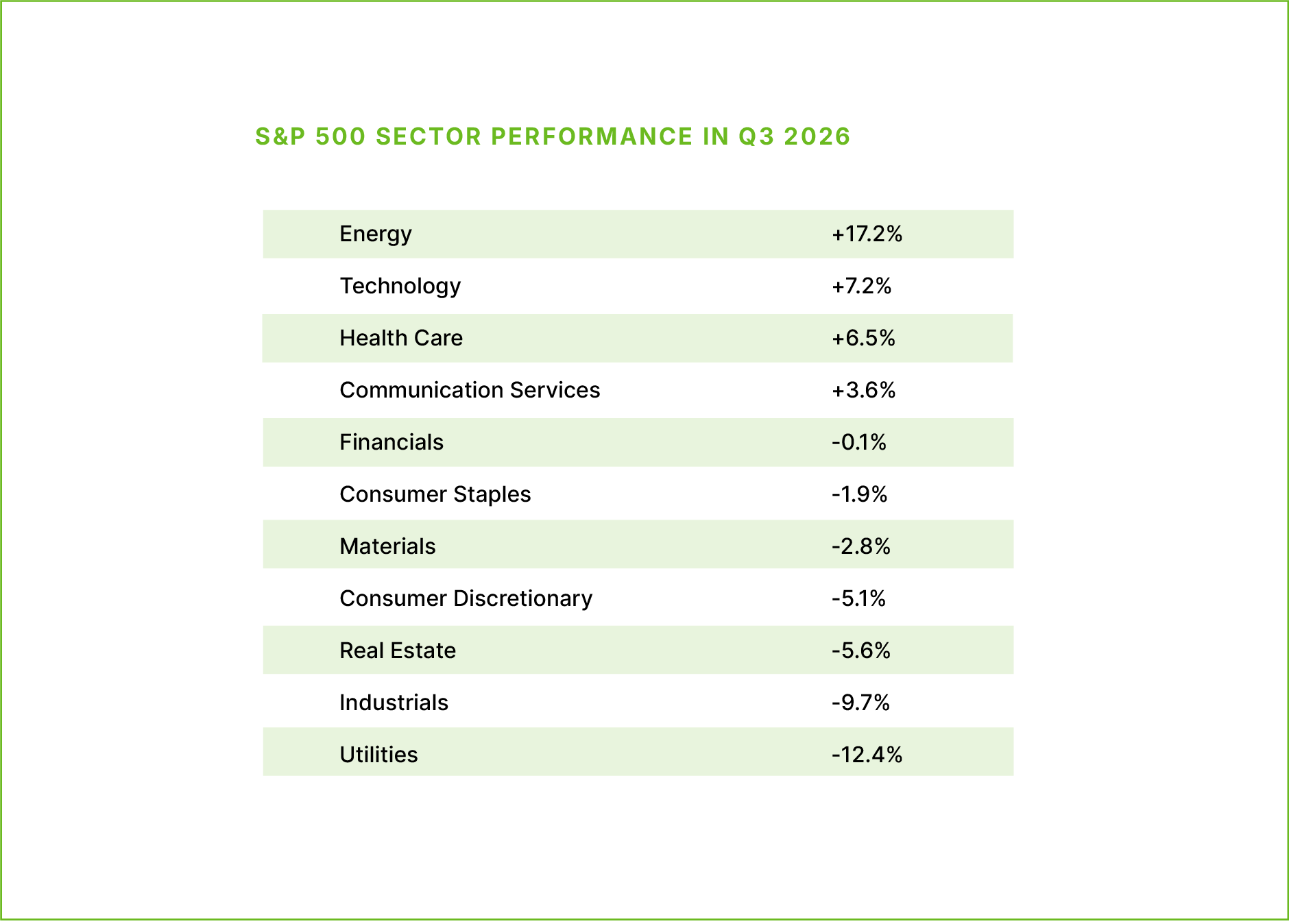
The same dispersion was visible at the company level. At the end of September, the S&P 500 was close to its record high, but the median company in the index was approximately 17% below its own high. This is the narrowest market breadth we’ve seen since the dot-com era.
A number of solid businesses with positive free cash flow and accelerating earnings were caught in the crossfire, as investors rapidly repriced interest-rate sensitivity, capital intensity, valuation, and exposure to the AI infrastructure cycle.
WestEnd’s Core Strategy declined -4.8% net of fees for the third quarter, giving up some of our lead over the S&P 500 Index for the year. However, even with the challenging quarter, we are still outperforming for the year.
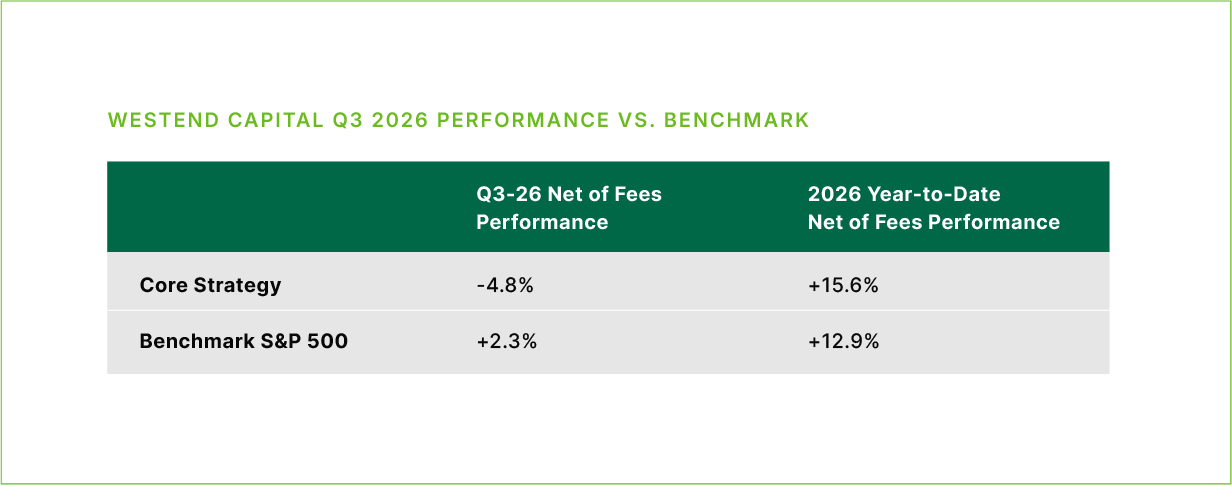
*Performance values as of September 30, 2026
Please note that these performance figures represent a weighted average of return for each strategy, based on a sampling of actual accounts. The accounts used to measure weighted average performance were generally portfolios that were invested for the entire quarter and were not subject to extraneous factors like scheduled withdrawals, account restrictions, and other factors. The weighted average was based on 131 Core portfolios. Actual performance results may differ from composite returns, depending on the size of the account, investment guidelines and/or restrictions, inception date and other factors. Please see the index disclaimers for the S&P 500 at the end of this review. Past performance is not indicative of future results.
A difficult quarter in stock-price terms does not necessarily mean the earnings power of our underlying companies has deteriorated. Many Core holdings continue to operate with strong backlogs, durable demand, healthy free cash flow, and compelling long-term opportunities.
At the same time, we do not dismiss price action or assume every holding will recover simply because we like the business. A rapidly changing rate environment requires us to continuously re-evaluate position sizes, valuations, earnings visibility, and where capital has the greatest potential to compound from here—which is why we have broadened the portfolio in recent weeks.
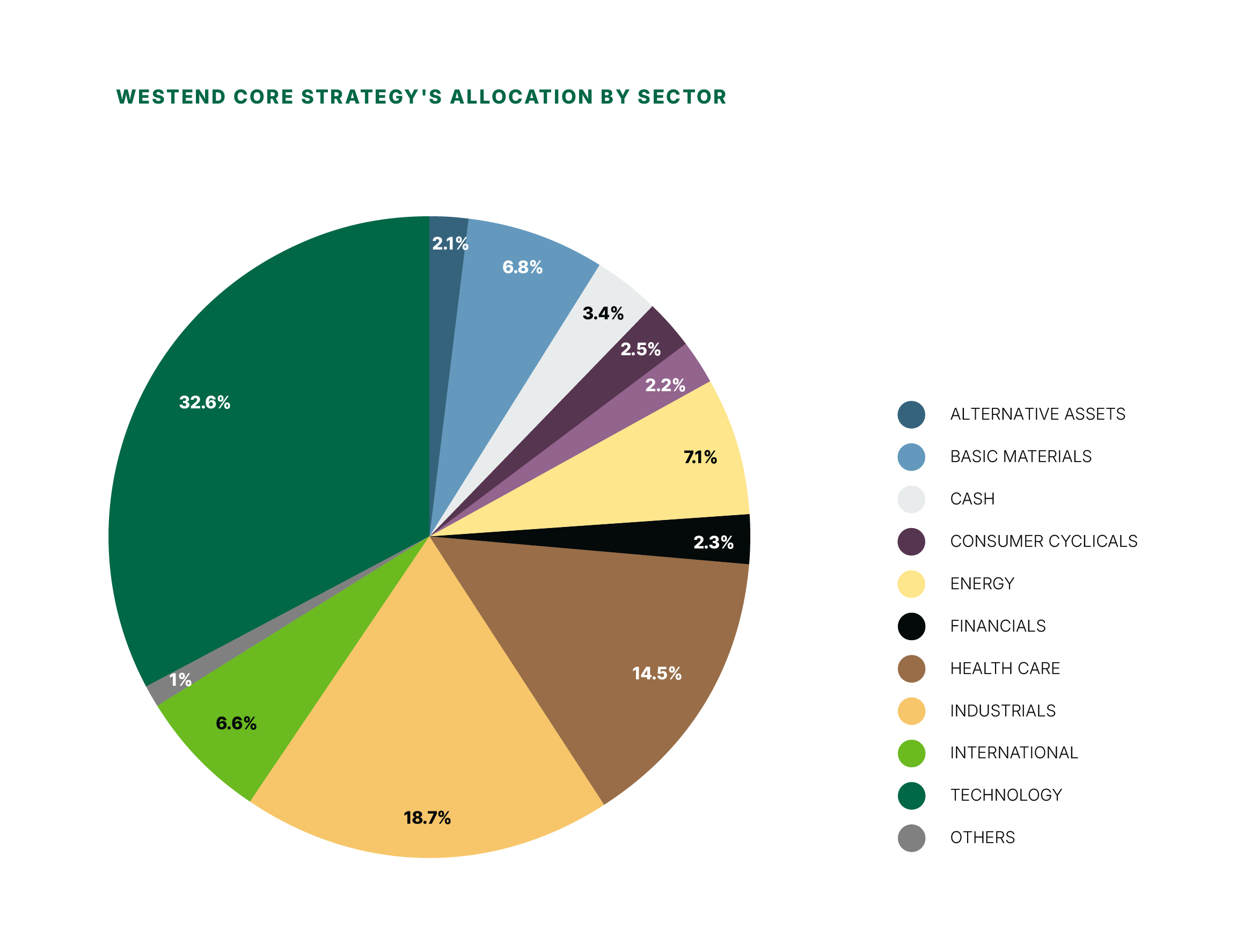
AI infrastructure remains one of the strongest investment cycles we have ever witnessed, so Technology remains a stronghold in the portfolio. But it is also confronting a higher cost of capital, questions about the timing of returns, growing use of debt, and political scrutiny surrounding data centers’ effects on utility bills, water consumption, and local infrastructure. That’s meant being more selective within the sector, and shifting capital to sectors with attractive valuation profiles and strong forward earnings outlooks.
Recent portfolio decisions illustrate how we are putting these ideas into practice.
Increasing Exposure to Healthcare

As clients and prospects are reading this letter, Senior Equity Analyst Ali Mogharabi and Portfolio Manager George Bolton will be in Madrid, Spain attending the ESMO Congress from October 23–27. The annual meeting’s comprehensive scientific and educational program is designed to encourage discussion of translational cancer science and newly presented clinical research.
Attending in person will allow the team to review emerging oncology data firsthand, compare competing therapeutic approaches, and speak with researchers, clinicians, and industry participants. That work can help us pressure-test the investment cases behind current holdings, while identifying additional companies and technologies that warrant deeper research.
Buy:

Health Care was the main beneficiary of our effort to add earnings drivers that are less dependent on data-center construction and the cost of long-duration capital.
We have held Eli Lilly for some time, and more recently, we added GE HealthCare and Merck as turnaround opportunities at valuations we considered attractive. We also established a position in Moderna after encouraging Phase 3 melanoma results from its personalized cancer-vaccine collaboration with Merck.
The Moderna thesis extends beyond a single indication. Melanoma is an important first test, but the same platform may eventually have applications across larger cancer categories, including lung, bladder, kidney, colorectal, gastric, and head-and-neck cancers. The ultimate opportunity will depend on clinical results, regulatory approvals, and adoption, and those processes will take years. But if the platform proves effective across multiple indications, we believe it could create a meaningful new earnings stream that has little direct connection to the AI infrastructure cycle.
Sell:

We purchased Boeing in December 2024 based on a straightforward turnaround thesis. The company operates within a global commercial-aircraft duopoly, possesses a substantial backlog, and appeared positioned to generate meaningful earnings and cash-flow improvement as production normalized. But that recovery never became consistent enough.
The company continued to take one step forward and two steps back. Regulatory delays persisted, deliveries remained uneven, a 737 MAX software issue created another disruption, MAX 10 certification moved further out, and the 777X experienced another year-long delay. A potential 200-aircraft agreement with China also remained at the government-discussion stage rather than becoming a firm addition to Boeing’s backlog.
A backlog is valuable only if a company can convert it into delivered aircraft, earnings, and free cash flow. We concluded that Boeing was not producing that operating leverage with sufficient consistency, and we exited the position in full.
Buy:
Meta Platforms

Meta’s Muse initiative helped give us greater confidence that the company can translate its enormous AI spending into measurable returns. While the commercial potential of the hardware itself remains uncertain, Muse offered a clearer path to monetization through Meta’s existing ecosystem: deeper engagement, more effective advertising, and agentic AI that could eventually help users complete purchases and transactions directly within Meta’s platforms.
We think this is important because Meta already operates one of the world’s largest digital advertising businesses. If AI can improve targeting, conversion, and commerce while also creating opportunities for Meta to participate in transaction revenue, the company has a path to earn a return on its infrastructure investment without relying on an entirely new business model. In our view, that combination strengthened the earnings case and modestly broadened the company’s revenue opportunity beyond advertising alone.
Buy:

Foundation models can generate and analyze information, but enterprises and government agencies still need to integrate fragmented, sensitive, and often incompatible data systems before those models can be useful.
That is where we believe Palantir has established an important position. Its Artificial Intelligence Platform sits within the difficult data-integration layer that general-purpose models cannot easily replace. As deployments expand, Palantir’s software can become more deeply embedded in customers’ operations, supporting durable and increasingly valuable contracts.
Its government and defense franchise adds another source of resilience, supported by multi-year programs that are difficult to displace. As the company’s growth trajectory became increasingly clear, we concluded that the valuation offered a more attractive balance of risk and potential return.
Buy:

We have remained skeptical of many traditional seat-based software models, where AI may reduce switching costs, lower barriers to entry, or allow customers to accomplish more with fewer licenses.
Snowflake is positioned differently. Enterprise AI projects require clean, governed, accessible data, and Snowflake is already an important data platform for thousands of large organizations across Amazon Web Services, Microsoft Azure, and Google Cloud.
That installed position allows Snowflake to benefit as customers run additional AI workloads through its platform. Its consumption-based model means revenue is tied more closely to actual usage than to the number of software seats sold. Snowflake is also largely agnostic about which large-language model ultimately wins; its opportunity depends on workloads using governed enterprise data, not on the success of one particular model.
Looking Ahead
The third quarter was challenging for Core, and we do not minimize that result. But the quarter also demonstrated why index-level returns can provide an incomplete picture of what investors are experiencing beneath the surface.
Interest rates reset higher, seven of 11 S&P 500 sectors declined, and many quality companies were repriced even as the aggregate index finished positive. We used that environment to reassess positions, exit a turnaround that was not progressing as expected, add selectively to AI beneficiaries where the earnings case remained compelling, and broaden Health Care exposure around a different set of long-term opportunities.
We expect capital to continue rotating as investors adjust to a higher-rate environment. Some of that process may remain uncomfortable in the short run. But rotation also creates valuation gaps, and strong businesses do not stop generating earnings simply because market leadership narrows for a quarter. A market with wider dispersion is an especially fertile environment for active management.

Notes and Disclaimers
This newsletter has been prepared solely for the client to whom it was directed and may not be sent to any other party. Further, it contains highly confidential and proprietary information and trade secrets that are of independent, economic value to us. Any disclosure of this information could cause us competitive harm. By accepting this newsletter, you agree to keep strictly confidential all of its contents and may not reproduce, distribute, share or publish in any manner without our prior written consent. This letter is not, and is not intended to be, an advertisement within the meaning of Advisers Act Rule 206(4)-1.
Further, a substantial part of this newsletter contains forward-looking statements within the meaning of the federal securities laws, including in particular statements appearing on page 3. Forward-looking statements are those that predict or describe future events or trends and that do not relate solely to historical matters. For example, forward-looking statements may predict future economic performance, describe plans and objectives of management for future operations and make projections of revenue, investment returns or other financial items. A prospective investor can generally identify forward-looking statements as statements containing the words “will,” “believe,” “expect,” “anticipate,” “intend,” “contemplate,” “estimate,” “assume” or other similar expressions. Such forward-looking statements are inherently uncertain, because the matters they describe are subject to known (and unknown) risks, uncertainties and other unpredictable factors that are beyond our control. Actual results could and likely will differ, sometimes materially, from those projected or anticipated. We are not undertaking any obligation to update or revise any forward-looking statements whether as a result of new information, future events or otherwise. You should not take any statements regarding past trends as a representation those trends or activities will continue in the future. Accordingly, you should not put undue reliance on these statements.
In preparing this newsletter, we have relied upon information provided by the custodian(s) and other third-party sources we believe to be reliable and accurate.
Past performance does not guarantee future results. Different types of investments involve varying degrees of risk and there can be no assurance that the future performance of any specific investment or investment strategy will be profitable. Changes in investment strategies, contributions or withdrawals, and economic and market conditions will materially alter the performance of your account. All investing involves risk of loss including the possible loss of all amounts invested.
Index Disclaimers
The benchmarks referenced are included to reflect the general trend of the markets during the periods indicated and are not intended to imply that the underlying returns were comparable to the market indices either in composition or element of risk. There are significant differences between client accounts and the indices herein including, but not limited to, risk profile, liquidity, volatility, and asset composition.
The S&P 500 Index is a capitalization-weighted index comprised of 500 stocks chosen for market size, liquidity and broad industry group representation within the U.S. economy. Index returns represent gross returns, and are provided to represent the investment environment during the time periods shown and are not covered by the report of the independent verifiers.