Maintaining Conviction in an Unsettled Market

The ongoing war in the Middle East continues to disrupt energy markets and raise understandable questions about downstream impacts on inflation, consumer spending, and global growth. It’s challenging to open the news every day and see constant headlines about escalating conflict, tighter energy markets, and the possibility of broader economic fallout.
WestEnd Senior Equity Analyst Ali Mogharabi has emphasized a simpler way to think about the geopolitical situation: rather than trying to weigh every variable at once, think about the risks in terms of duration.

Ali Mogharabi
Senior Equity Analyst
“If the conflict lasts only a few months, risk premiums rise and energy names spike, but the economy likely absorbs the shock and normalizes.
If it stretches into the 6- to 12-month range, discretionary spending could begin to weaken, particularly in Europe and among less affluent consumers, while energy and defense continue to benefit.
If it drags into the 12- to 18-month range, overall demand likely weakens more meaningfully, putting pressure on volume-sensitive industrials and other cyclical areas, while defense, domestic energy, healthcare, and staples become relatively more resilient.
And if the disruption were to last well beyond that, the odds of recession would rise materially, leaving only the most inelastic areas of the market in stronger shape.”
Ali’s framework reinforces the convictions we have about our Core holdings going into this stretch.
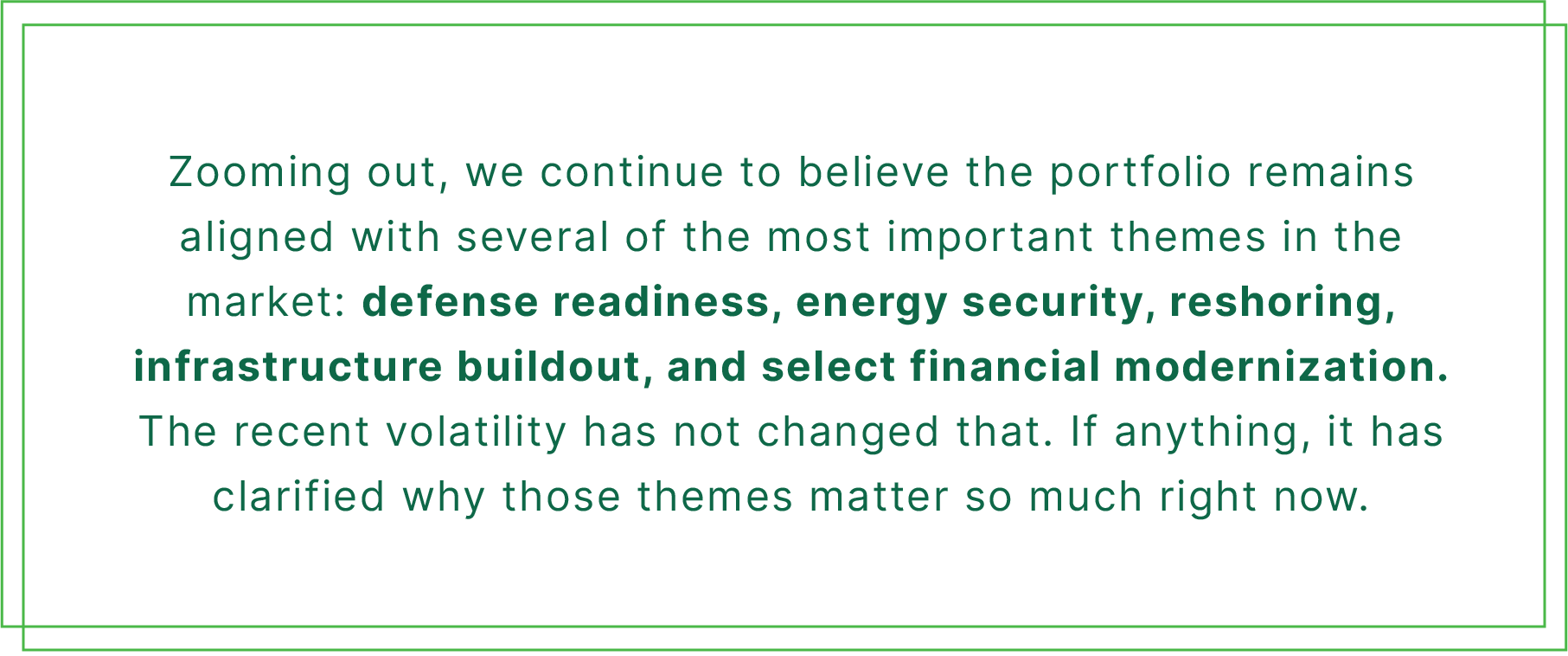
The portfolio was already tilted toward areas we believed were better suited to a world of higher geopolitical friction, including defense, industrial reshoring, power and electrification, select commodities, and certain forms of financial infrastructure. We continued to see developed economies and major corporations focusing spending on energy, data, infrastructure, and security all at the same time. We are confident the conflict will not reverse these trends, and in fact, it seems more likely to accelerate them.
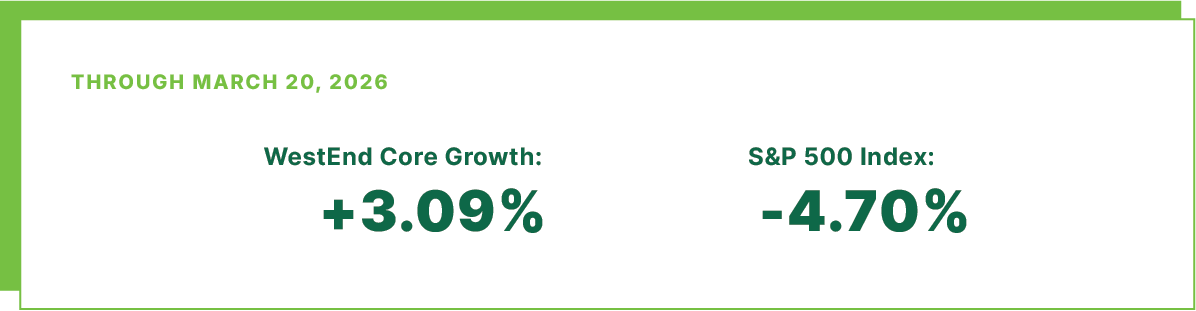
The Core Portfolio has held up year-to-date, and is outperforming the S&P 500 by a wide margin:
This doesn’t mean our response to volatility is to do nothing. Volatility gives us a chance to test assumptions, run scenarios, and think more clearly about where future opportunity may emerge if market reactions become overdone. Ali has built a matrix of war scenarios, timelines, risks, and various probabilities of impact to Core holdings and equity markets in general. We’re constantly analyzing and sharpening our understanding of what may be temporary, what is durable, and where the best uses of capital may be as conditions evolve.
When we pressure-test the portfolio this way, we are looking for businesses whose demand drivers are likely to persist even if the backdrop becomes more difficult. Fluor stands out on that front, and we added shares to Core Portfolios in February.
Buy

Fluor gives us exposure to long-duration capital spending in areas we believe are becoming more important, including government infrastructure, defense-related projects, energy investment, and potentially nuclear-related work as the need for reliable domestic power grows. It is the kind of business we continue to like in this environment, featuring broader spending priorities that could persist for years.
Wynn Resorts, meanwhile, is a useful example of how we think about re-ranking opportunities when the backdrop changes.
Sell

Wynn gave us a compelling reason to own. Dubai represented a massive long-term opportunity, in our view, with the potential to become the first major casino destination in the Middle East. If successful, that development could still prove to be an important long-duration asset and a meaningful growth driver for the company.
The war changed the thesis in the short term, however.
As the geopolitical backdrop deteriorated, travel-sensitive exposures became harder to underwrite on a relative basis. Wynn’s path to accelerating earnings growth became less attractive in the near term, especially compared to opportunities elsewhere in the portfolio. In a more unstable regional environment, a travel and leisure name with Middle East exposure simply carried a different set of risks than it did before.
Notes and Disclaimers
This newsletter has been prepared solely for the client to whom it was directed and may not be sent to any other party. Further, it contains highly confidential and proprietary information and trade secrets that are of independent, economic value to us. Any disclosure of this information could cause us competitive harm. By accepting this newsletter, you agree to keep strictly confidential all of its contents and may not reproduce, distribute, share or publish in any manner without our prior written consent. This letter is not, and is not intended to be, an advertisement within the meaning of Advisers Act Rule 206(4)-1.
Further, a substantial part of this newsletter contains forward-looking statements within the meaning of the federal securities laws, including in particular statements appearing on page 3. Forward-looking statements are those that predict or describe future events or trends and that do not relate solely to historical matters. For example, forward-looking statements may predict future economic performance, describe plans and objectives of management for future operations and make projections of revenue, investment returns or other financial items. A prospective investor can generally identify forward-looking statements as statements containing the words “will,” “believe,” “expect,” “anticipate,” “intend,” “contemplate,” “estimate,” “assume” or other similar expressions. Such forward-looking statements are inherently uncertain, because the matters they describe are subject to known (and unknown) risks, uncertainties and other unpredictable factors that are beyond our control. Actual results could and likely will differ, sometimes materially, from those projected or anticipated. We are not undertaking any obligation to update or revise any forward-looking statements whether as a result of new information, future events or otherwise. You should not take any statements regarding past trends as a representation those trends or activities will continue in the future. Accordingly, you should not put undue reliance on these statements.
In preparing this newsletter, we have relied upon information provided by the custodian(s) and other third-party sources we believe to be reliable and accurate.
Past performance does not guarantee future results. Different types of investments involve varying degrees of risk and there can be no assurance that the future performance of any specific investment or investment strategy will be profitable. Changes in investment strategies, contributions or withdrawals, and economic and market conditions will materially alter the performance of your account. All investing involves risk of loss including the possible loss of all amounts invested.
Index Disclaimers
The benchmarks referenced are included to reflect the general trend of the markets during the periods indicated and are not intended to imply that the underlying returns were comparable to the market indices either in composition or element of risk. There are significant differences between client accounts and the indices herein including, but not limited to, risk profile, liquidity, volatility, and asset composition.
The S&P 500 Index is a capitalization-weighted index comprised of 500 stocks chosen for market size, liquidity and broad industry group representation within the U.S. economy. Index returns represent gross returns, and are provided to represent the investment environment during the time periods shown and are not covered by the report of the independent verifiers.