What Q1 Earnings Season Tells Us About the Core Portfolio

WestEnd clients know what we care about most when it comes to our portfolio companies: earnings.
It follows that every earnings season gives us the ability to stress-test our holdings, prove or disprove our convictions, and run quality control on our ideas.
For Q1 2026, our earnings scorecard was broadly encouraging.
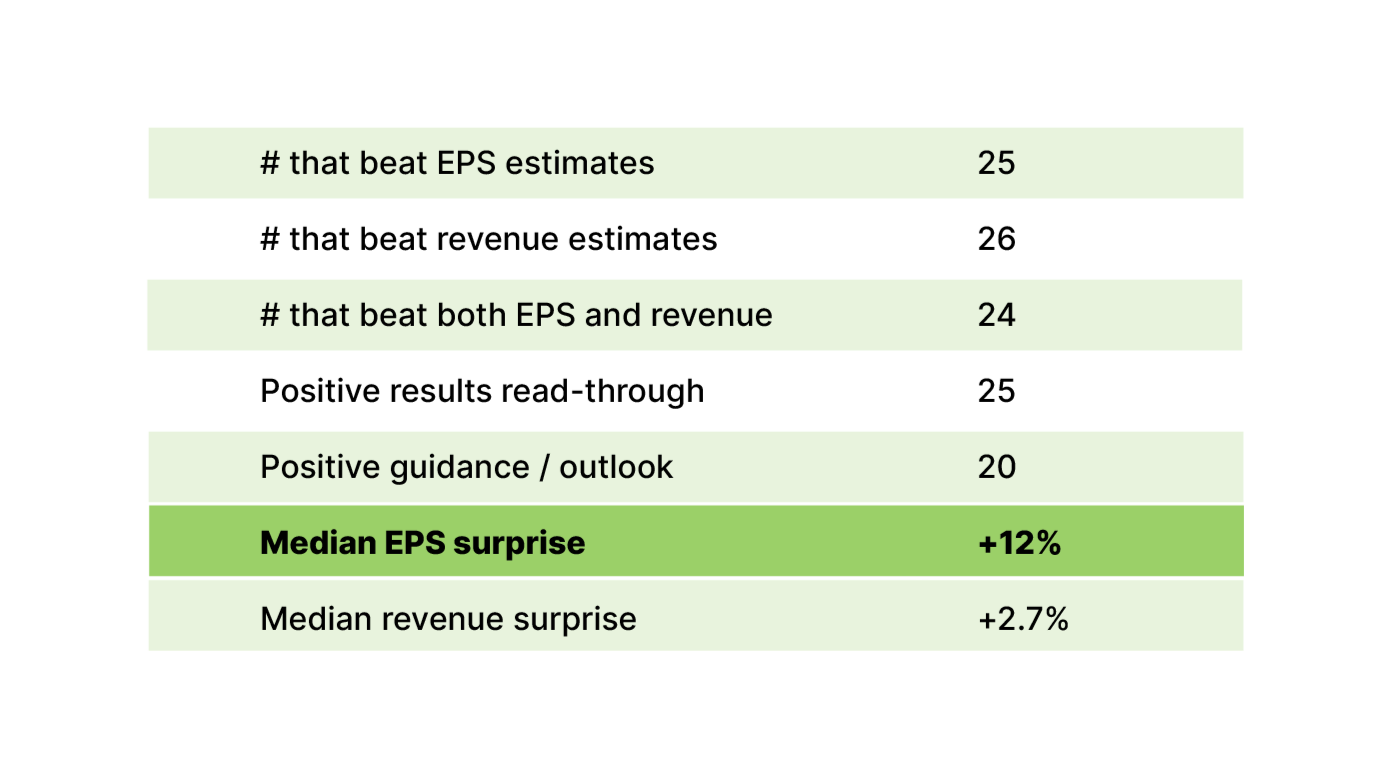
Across the 29 Core holdings in our earnings tracker that had reported first-quarter results at the time of this writing, earnings and revenue beats were widespread and management commentary was broadly constructive. All told, it was a strong earnings quarter on paper, but it also provided further evidence that we’re well-positioned in ‘growthy’ parts of the economy.
For the 29 Core Holdings That Served as Part of our Analysis:
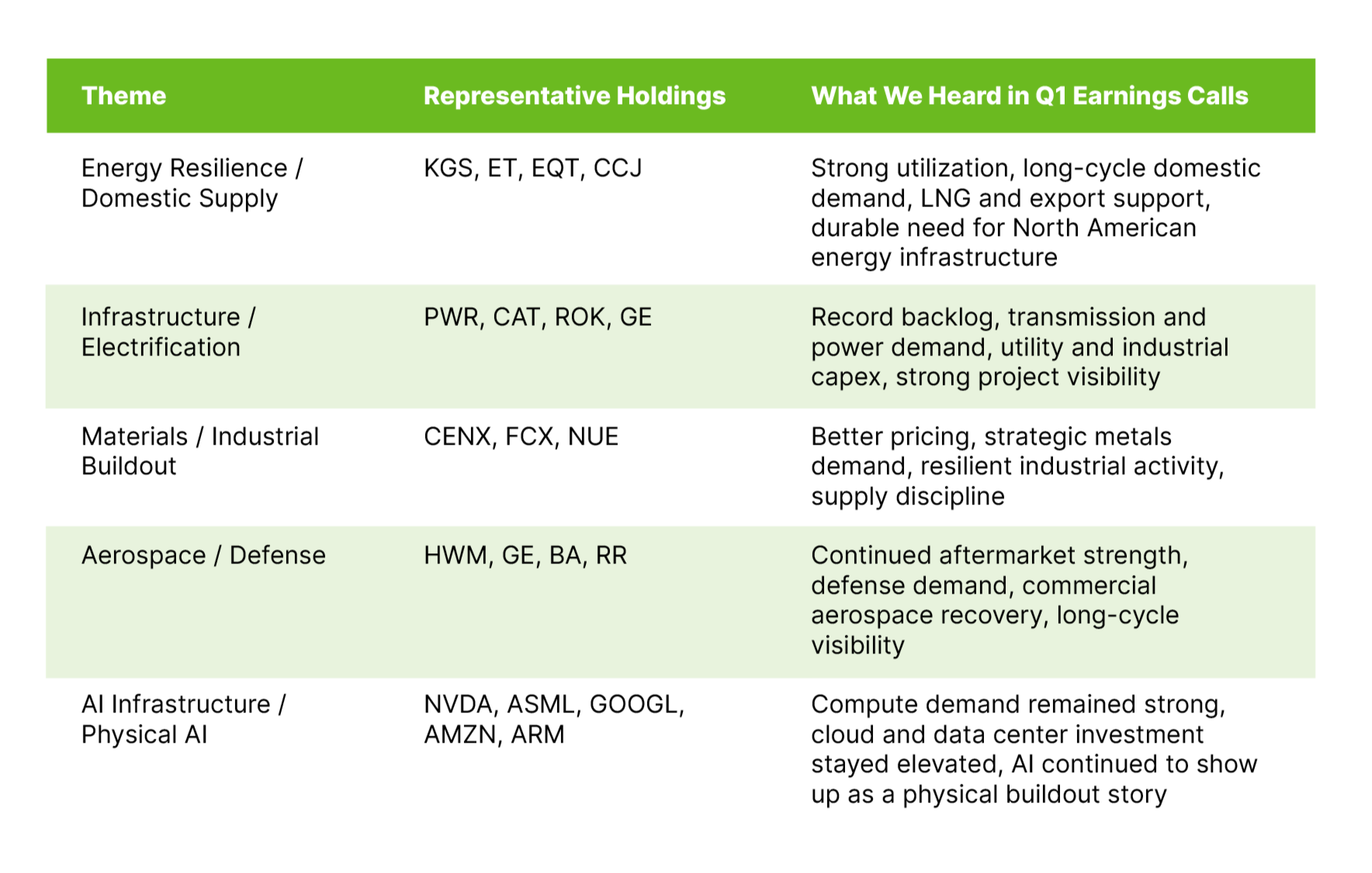
Just as importantly, management commentary across the portfolio continued to reinforce many of the themes WestEnd has been emphasizing for some time.
Not Every Earnings Report Was Good—
Fluor Corp.
Fluor offers a case study for how a sizable earnings disappointment can trigger a tactical response in the portfolio. After the company’s disappointing Q1 results introduced more near-term execution risk and lowered the stock’s upside, WestEnd did not hesitate to sell.
Key developments from the quarter for Fluor included:
Revenue of $3.6 billion, down about 8% year over year
Adjusted EPS of $0.14 on expected EPS of $0.66, a substantial miss
2026 adjusted EBITDA guidance narrowed to $525 million–$560 million, from $525 million–$585 million
Management cited cost growth on a mining project in the Americas
Management also cited a temporary slowdown on another project due to Middle East geopolitical concerns
To be clear, Fluor did not report a broken business. The company still ended the quarter with roughly $3.2 billion in cash and marketable securities and backlog of about $25.7 billion. But in our view, this report changed the near-term risk/reward. In a quarter where many Core holdings were beating expectations, raising guidance, or reinforcing strong demand trends, Fluor introduced a different set of variables: project cost growth, geopolitical disruption, and a lower ceiling on full-year expectations.
We view our decision to sell as risk management in practice. Successful investing requires not only identifying strong opportunities, but also reassessing positions quickly when execution risk rises and the return profile weakens.
Notes and Disclaimers
This newsletter contains highly confidential and proprietary information and trade secrets that are of independent, economic value to us. Any disclosure of this information could cause us competitive harm. This letter is not, and is not intended to be, an advertisement within the meaning of Advisers Act Rule 206(4)-1.
Further, a substantial part of this newsletter contains forward-looking statements within the meaning of the federal securities laws. Forward-looking statements are those that predict or describe future events or trends and that do not relate solely to historical matters. For example, forward-looking statements may predict future economic performance, describe plans and objectives of management for future operations and make projections of revenue, investment returns or other financial items. A prospective investor can generally identify forward-looking statements as statements containing the words “will,” “believe,” “expect,” “anticipate,” “intend,” “contemplate,” “estimate,” “assume” or other similar expressions. Such forward-looking statements are inherently uncertain, because the matters they describe are subject to known (and unknown) risks, uncertainties and other unpredictable factors that are beyond our control. Actual results could and likely will differ, sometimes materially, from those projected or anticipated. We are not undertaking any obligation to update or revise any forward-looking statements whether as a result of new information, future events or otherwise. You should not take any statements regarding past trends as a representation those trends or activities will continue in the future. Accordingly, you should not put undue reliance on these statements.
In preparing this newsletter, we have relied upon information provided by the custodian(s) and other third-party sources we believe to be reliable and accurate.
Past performance does not guarantee future results. Different types of investments involve varying degrees of risk and there can be no assurance that the future performance of any specific investment or investment strategy will be profitable. Changes in investment strategies, contributions or withdrawals, and economic and market conditions will materially alter the performance of your account. All investing involves risk of loss including the possible loss of all amounts invested.